Purpose: To help us endure the pain and weariness that can come form doing God’s work.
Scripture: Isaiah 49:5-6, 50:4-9
In last weeks lesson we learned of the mission of God’s servant. That mission is to "bring forth justice to the nations." We also learned that the justice brought by the servant may not fit the popular definitions of justice. In our culture justice is usually seen as judgement or "getting what you deserve." A more accurate definition of justice as used in these passages from Isaiah is: to restore order and wholeness to creation; order and wholeness as God originally intended. This could be described with a term that we are more familiar with in this context and that is: salvation. God’s plan of salvation is the justice that will be brought forth by the servant. We also learned in last weeks lesson that as the Body of Christ, we are God’s servant in our world. The servant has been interpreted in different ways by different people. Jews traditionally view the servant as Israel. Christians view the servant as Jesus or some other individual. I tend to believe that both views are true. Jesus did, in his lifetime, fulfill much of the servants mission. Israel as the chosen people of God did prior to Jesus fulfill much of the servants mission. Christians as the adopted children of God and as the Body of Christ in the world have and continue to fulfill the servants mission. We are the hands and feet of Christ. Our mission is justice; justice in the Biblical sense, not the justice or judgement so common in our world. The servant carries out the mission with humility and love and concern for those most in need of this justice. The servant will continue the mission until justice is established on earth.
This week we will learn more of the servant’s mission.
Before we get to this weeks scripture, let’s read another passage. This one from Psalm 1:1-3:
Blessed is the man who walks not in the counsel of the wicked, nor stands in the way of sinners, nor sits in the seat of scoffers; but his delight is in the law of the LORD, and on his law he meditates day and night. He is like a tree planted by streams of water that yields its fruit in its season, and its leaf does not wither. In all that he does, he prospers.
(Psa 1:1-3 ESV)
Does this passage sound like it describes one who is faithful to the task of serving God?
In what sense will all servants of God "prosper"?
Are the faithful promised a carefree, blissful life?
We are not promised a life free from suffering. We are promised sustenance. We are promised success in that God’s will will be accomplished. But, sometimes suffering accompanies and is a necessary component for fulfilling the mission of God. In this weeks scripture we will read a description of the suffering of the servant. The servant was on God’s mission, working for justice and suffering became apart of the mission. In what way is suffering a part of our mission? Does our mission always include suffering?
When we face suffering, what is our best source of strength that we can call on to help us endure suffering and to sustain us through our suffering?
And now the LORD says, he who formed me from the womb to be his servant, to bring Jacob back to him; and that Israel might be gathered to him-- for I am honored in the eyes of the LORD, and my God has become my strength-- he says: "It is too light a thing that you should be my servant to raise up the tribes of Jacob and to bring back the preserved of Israel; I will make you as a light for the nations, that my salvation may reach to the end of the earth."
(Isa 49:5-6 ESV)
There is no doubt of the servant’s call. "Formed from the womb to be his servant" tells of a special relationship with God throughout every moment of the servants life, even prior to birth. There are only a handful of stories in Scripture that relate a consciousness of mission from infancy.
Can you name any of them?
The hand of God seemed to be there as infant Moses was rescued from the water and from Pharaoh’s decree. Jeremiah contained language very similar to this passage:
"Before I formed you in the womb I knew you, and before you were born I consecrated you; I appointed you a prophet to the nations."
(Jer 1:5 ESV)
Samuel was dedicated by his mother to the service of God. Both Jesus and John the Baptist were born under circumstances that marked them as chosen by God.
Are all servants "called from the womb"?
What do we learn from these verses about the mission of the servant?
The first is that the servant is to bring Israel back to God, a rescue mission, and the second is to offer salvation to "the end of the earth". God wanted the nation of Israel to be the servant through whom salvation would be extended to the world. Instead, Israel fell to sinfullness. The servants call here is to restore Israel so that Israel could accomplish it’s mission.
How does this relate to us today?
We, as Christians, must work toward fulfilling Israel’s mission of bringing all people to God. Jesus did fulfill the servants call to offer salvation to all who believe. The mission is extended to evangelize those who are not already part of God’s family. This is a mission that we all are called to fulfill. We are many times shocked when we find that while working to spread the gospel and bring the world justice, suffering will join us on our mission.
The Lord GOD has given me the tongue of those who are taught, that I may know how to sustain with a word him who is weary. Morning by morning he awakens; he awakens my ear to hear as those who are taught. The Lord GOD has opened my ear, and I was not rebellious; I turned not backward. I gave my back to those who strike, and my cheeks to those who pull out the beard; I hid not my face from disgrace and spitting. But the Lord GOD helps me; therefore I have not been disgraced; therefore I have set my face like a flint, and I know that I shall not be put to shame. He who vindicates me is near. Who will contend with me? Let us stand up together. Who is my adversary? Let him come near to me. Behold, the Lord GOD helps me; who will declare me guilty? Behold, all of them will wear out like a garment; the moth will eat them up.
(Isa 50:4-9 ESV)
What does God do for His servant?
God teaches. Each day God provides the servant with the necessary knowledge to carry the mission to the "weary" of the world.
Come to me, all who labor and are heavy laden, and I will give you rest. Take my yoke upon you, and learn from me, for I am gentle and lowly in heart, and you will find rest for your souls. For my yoke is easy, and my burden is light."
(Mat 11:28-30 ESV)
Who are the weary of the world?
What can servant Jesus offer them?
What can we as servants of God offer them?
How does the servant respond to God’s knowledge?
God opens the servants ear. The servant makes full use of the knowledge given by God. "I was not rebellious, I did not turn backward." The servant progresses the mission. In this way the servant differs from Israel. Jesus did not turn away from His mission. We should never turn away from ours.
Jesus always submitted to the will of the Father. Do we share this quality? Is the mission always our first priority?
Verse 6 tells of the suffering of the servant.
Verse 6: "I gave my back to those who strike, and my cheeks to those who pull out the beard; I hid not my face from disgrace and spitting."
Now compare:
Mat 26:67 Then they spit in his face and struck him. And some slapped him,
Jesus was also beaten and whipped. He allowed the punishment to happen. He did not resist. He literally gave his back to those who struck. Verse 6 is not a description of a helpless victim. Why did Jesus willingly allow himself to be abused in this way?
Because it was His mission and because of His tremendous love for us.
How can suffering actually help to define a person’s ability to lead?
How a person deals with rebuke or pressure speaks volumes about strength of character or personal commitment. Someone who falls apart under light stress is unlikely to be an effective leader when the pressure is really on.
What resources does God provide the servant in order to sustain him in the face of persecution and suffering?
Verses 7 and 9 tell us that God help us. We cannot be disgraced. We are innocent. The servant knows his mission and is secure in his calling and in his relationship with God. Because God is with the servant, the servant is willing to endure suffering. The servant has infinite confidence the God will sustain him.
Psa 46:1 God is our refuge and strength, a very present help in trouble.
What lesson is learned from today’s verses?
1. Doing God’s work does not make us immune to suffering. (Many times it actually leads to suffering.)
2. Our refuge and strength is always present.
3. We are given knowledge from God. We must listen and learn.
We, as servants, must always remember this. We will face suffering. We will grow tired. Our strength and refuge is always there. When we encounter a dark place in our life, God will provide.
Saturday, December 10, 2005


Thursday, December 08, 2005
A quarter pound of salt...
Here is a great essay that fits in perfectly with what I've been studying and reading lately...
Wednesday, December 07, 2005
What's So Amazing About Grace - The Final Chapter

Tonight our group will conclude our discussion of Philip Yancey's What's So Amazing About Grace . I am just going to share a few select quotes from the last three chapters:
From Chapter 18 - "Serpent Wisdom"
"...a coziness between church and state is good for the state and bad for the church."
"President Eisenhower told the nation in 1954, 'Our government makes no sense unless it is founded on a deeply felt religious faith- and I don't care what it is.'"
"Religion defines evil and gives people the moral strength to resist. As 'the conscience of the state,' we help inform the world about justice and righteousness....In that civic sense, Eisenhower was right: society needs religion, and it matters little what kind."
"We dare not ... forget the last part of [the] aphorism: while a coziness between church and state may be good for the state, it is bad for the church. Herein lies the chief danger to grace: the state, which runs by the rules of ungrace, gradually drowns out the church's sublime message of grace."
"Insatiable for power, the state may well decide that the church could prove even more useful if the state controlled it."
"The cozier it gets with government, the more watered down its message becomes. The gospel itself changes as it devolves into civil religion."
"In sum, the state must always water down the absolute quality of Jesus' commands and turn them into a form of external morality - precisely the opposite of the gospel of grace."
"Read the Sermon on the Mount and try to imagine any government enacting that set of laws."
(I find it hard to imagine any church enacting that set of laws. -tony-)
"A state government can shut down stores and theaters on Sunday, but it cannot compel worship. It can arrest and punish KKK murderers, but cannot cure their hatred, much less teach them love. It can pass laws making divorce more difficult but cannot force husbands to love their wives and wives their husbands. It can give subsidies to the poor but cannot force the rich to show them compassion and justice. It can ban adultery but not lust, theft but not covetousness, cheating but not pride. It can encourage virture but not holiness."
Chapter 19 - "Patches of Green"
"Gallop polls say eighty-three percent of Americans believe the nation is in moral decline."
"Once a Christian consensus has faded, once religious faith has been snipped away from society, what happens then?"
"A renewal of spirituality in the United States will not descend from the top down; if it occurs at all, it will start at the grass roots and grow from the bottom up."
"Jesus' images portray the kingdom as a kind of secret force. Sheep among wolves, treasure hidden in a field, the tiniest seed in the garden, wheat growing among the weeds, a pinch of yeast worked into bread dough, a sprinkling of salt on meat - all these hint at a movement that workd within society, changing it from the inside out. you do not need a shovelful of salt to preserve a slab of ham; a dusting will suffice.
Jesus did not leave an organized host of followers, for he knew that a handful of salt would gradually work its way through the mightiest empire in the world. Against all odds, the great institutions of Rome - the law code, libraries, the Senate, Romand legions, roads, aqueducts, public monuments - gradually crumbles, but the little band to whom Jesus gave these images prevailed and continues on today.
Soren Kierkegaard described himself as a spy, and indeed Christians behave like spies, living in one world while our deepest allegiance belongs to another. We are resident aliens, or sojourners, to use a biblical phrase."
"All too often the church holds up a mirror reflecting back the society around it, rather than a window revealing a different way.
If the world despises a notorious sinner, the church will love her. If the world cuts off aid to the poor and the suffering, the church will offer food and healing. If the world oppresses, the church will raise up the oppressed. If the world shames a social outcast, the church will proclaim God's reconciling love. If the world seeks profit and self-fulfillment, the church seeks sacrifice and service. If the world demands retribution, the church dispenses grace. If the world splinters into factions, the church joins together in unity. If the world destroys its enemies, the church loves them."
I wonder if he sees the same church that I see. I think there should be a "should" entered after every entry for "church" in that paragraph, because while the church should do all those things, I don't believe that we can make an absolute statement that the church does in fact do those things. -tony-
"Some observers have called the United States the most religious nation on earth. If true...shouldn't a quarter pound of salt be having more effect on a pound of meat?
Surely a peculiar people should demonstrate a higher standard of personal ethics than the surrounding world."
"Far from being peculiar, modern Christians tend to look just like everyone else, only more so. Unless our personal ethics rise above the level around us, we can hardly hope to act as a moral preservative."
Chapter 20 - "Gravity and Grace"
"I escape the force of spiritual 'gravity' when I begin to see myself as a sinner who cannot please God by any method of self-improvement or self-enlargement. Only then can I turn to God for outside help - for grace - and to my amazement I learn that a holy God already loves me despite my defects. I escape the force of gravity again when I recognize my neighbors also as sinners, loved by God."
"We creatures, we jolly beggars, give glory to God by our dependence. Our wounds and defects are the very fissures through which grace might pass. It is our human destiny on earth to be imperfect, incomplete, weak, and mortal, and only by accepting that destiny can we escape the force of gravity and recieve grace. Only then can we grow close to God.
Strangely, God is closer to sinners than to 'saints'. (By saints I mean those people renowned for their piety - true saints never lose sight of their sinfulness.) As one lecturer in spirituality explains it, 'God in heaven holds each person by a string. When you sin, you cut the string. Then God ties it up again, making a knot - and thereby bringing you a little closer to him. Again and again your sins cut the string - and with each further knot God keeps drawing you closer and closer.'"
"Church should be a haven for people who feel terrible about themselves - theologically, that is our ticket for entry. God needs humble people (which usually means humbled people) to accomplish his work. Whatever makes us feel superior to other people, whatever tempts us to convey a sense of superiority, that is gravity, not grace."
"...church should exist for those who need its help, and not for those who by their own profession are so good already that it is they who help the church"
'nuff said...
Friday, December 02, 2005
Sunday School Lesson: Serving Others

Purpose: To help us embody the vision of justice that God announced through the servant.
Scripture: Isaiah 42:1-8
When you hear the word "justice" what comes to mind?
Do you think of the American ideal of "justice for all" that is founded on the belief that every person is entitled to justice? That is that all are entitled to fair treatment according to our laws and principles regardless of race, religion, ethnicity, etc. Do you believe that we really practice "justice for all"?
-or-
Do you think of justice in terms of "getting what you deserve"? Justice as a result of judgement?
Do you think either of these two thoughts of justice are the meaning when we find the term "justice" in scripture?
Behold my servant, whom I uphold, my chosen, in whom my soul delights; I have put my Spirit upon him; he will bring forth justice to the nations.
(Isa 42:1 ESV)
The same verse from the Message:
"Take a good look at my servant. I'm backing him to the hilt. He's the one I chose, and I couldn't be more pleased with him. I've bathed him with my Spirit, my life. He'll set everything right among the nations.
(Isa 42:1 MSG)
How does God introduce His servant? What will distinguish His servant? What is the source of the servant’s power?
The servant is God’s servant, personally appointed, not elected by man or given position by wealth or power. The servant of God is "bathed" with God’s Spirit.
What is the servant’s mission?
To "bring forth justice" and "set everything right".
Trick question:
Which of our definitions of "justice" is the justice brought by the servant?
Neither. The Jewish term here translated as "justice" is mishpat. Mishpat refers to God’s desire for wholeness, peace, righteousness, and order in creation. "To bring forth justice" is to work to restore all of creation to its Creator-intended state. (source: Adult Bible Studies Teacher)
The next three verses will give us a better description of the servant’s justice:
He will not cry aloud or lift up his voice, or make it heard in the street; a bruised reed he will not break, and a faintly burning wick he will not quench; he will faithfully bring forth justice. He will not grow faint or be discouraged till he has established justice in the earth; and the coastlands wait for his law.
(Isa 42:2-4 ESV)
These verses describe the methods the servant will use to bring forth justice. How does this description differ from how the world seeks justice?
He won't call attention to what he does with loud speeches or gaudy parades. He won't brush aside the bruised and the hurt and he won't disregard the small and insignificant, but he'll steadily and firmly set things right. He won't tire out and quit. He won't be stopped until he's finished his work--to set things right on earth. Far-flung ocean islands wait expectantly for his teaching."
(Isa 42:2-4 MSG)
What or who do you picture when you see the references to a "bruised reed" or a "dimly burning wick"?
In the book He Still Moves Stones, Max Lucado tells the story of the healing miracles of Jesus. Lucado uses the references to the bruised reed and smoldering wick to describe the people desperately in need of a miracle. In fact these very verses are repeated in Matthew 12 as a description of Jesus. Lucado divides his book into two sections, one entitled "The Bruised Reed" and the other "The Smoldering Wick". If you were asked to describe a person who fits the description of "bruised reed" or "dimly burning wick", how would you do so?
From Lucado’s book:
The Bruised Reed
It stood with assurance.
Head held high on strong stalk.
But that was before the careless bump, the harsh rain.
Now it’s bruised, bent. Weakened.
It seeks gentle fingers to straighten and not break.
It needs a firm touch to heal and not to hurt.
Tender power.
Soft strength.
Is there such a hand?
The Smoldering Wick
Fibers interwoven for flame
Flame ignited for light
Cold gusts - hot blasts
Candle overcome by night
yet
Stubborn ember struggles
Duels with shadows and seeks
Brighter flame for power
Dancing fire for heat.
Why do you think God chooses a nonviolent, almost timid servant rather than a servant whose strength is based on power or ability to give His enemies "what they deserve"?
Matthew took these verses to indicate that Jesus was the servant spoken of in this passage and Max Lucado followed up on that. Was the servant only present in the life and times of Jesus?
Who is the "servant" in our time?
Could we as Christians (the Body of Christ) be the servants?
How can we as the servant work for justice? (Justice in the biblical sense, i.e. restoring creation to it’s Creator-intended state)
He won't tire out and quit. He won't be stopped until he's finished his work--to set things right on earth.
(Isa 42:4 MSG)
We can rest assured the all that God promises, God will accomplish and we can work for (biblical) justice with renewed conviction.
Who in our world is most in need of justice?
Thus says God, the LORD, who created the heavens and stretched them out, who spread out the earth and what comes from it, who gives breath to the people on it and spirit to those who walk in it: "I am the LORD; I have called you in righteousness; I will take you by the hand and keep you; I will give you as a covenant for the people, a light for the nations, to open the eyes that are blind, to bring out the prisoners from the dungeon, from the prison those who sit in darkness. I am the LORD; that is my name; my glory I give to no other, nor my praise to carved idols.
(Isa 42:5-8 ESV)
GOD's Message, the God who created the cosmos, stretched out the skies, laid out the earth and all that grows from it, Who breathes life into earth's people, makes them alive with his own life: "I am GOD. I have called you to live right and well. I have taken responsibility for you, kept you safe. I have set you among my people to bind them to me, and provided you as a lighthouse to the nations, To make a start at bringing people into the open, into light: opening blind eyes, releasing prisoners from dungeons, emptying the dark prisons. I am GOD. That's my name. I don't franchise my glory, don't endorse the no-god idols.
(Isa 42:5-8 MSG)
How do we tend to view servanthood?
Have you ever thought of Jesus as a servant?
Do you view Christianity as a call to servanthood? Why or why not?
How does Jesus’ role as God’s servant challenge us to be more faithful servants?
Who are the bruised reeds and smoldering wicks in our society?
How can we bring them justice?
Sunday, November 27, 2005
Jesus gave His life for us - twice

I know that during Advent we look forward to the birth of Jesus rather than the Cross, but a startling thought came to me as I was reading last night: Jesus joining in our humanity was as great a sacrifice as Jesus’ death on the Cross.
This paragraph from William Barclay’s The Mind of Jesus, first published in 1960 is what led to this revelation:
The sacrifice begins with the Incarnation. He who was rich for our sakes became poor (II Cor. 8.9). It culminates upon the Cross, for Jesus, having loved his own, loved them to the end (John 13.1). But why the death of Christ? The death of Christ was necessary for this reason - if Jesus in his love had stopped short of the Cross, it would have meant that there was somewhere beyond which the love of God would not go, that there was something beyond which God would not forgive. On the Cross God says to us in Jesus Christ: ‘Nothing - absolutely nothing that you can do - can stop me loving you.’

It cost the life and death of Jesus to tell men what God is like.
Friday, November 25, 2005
Granny Atkinson
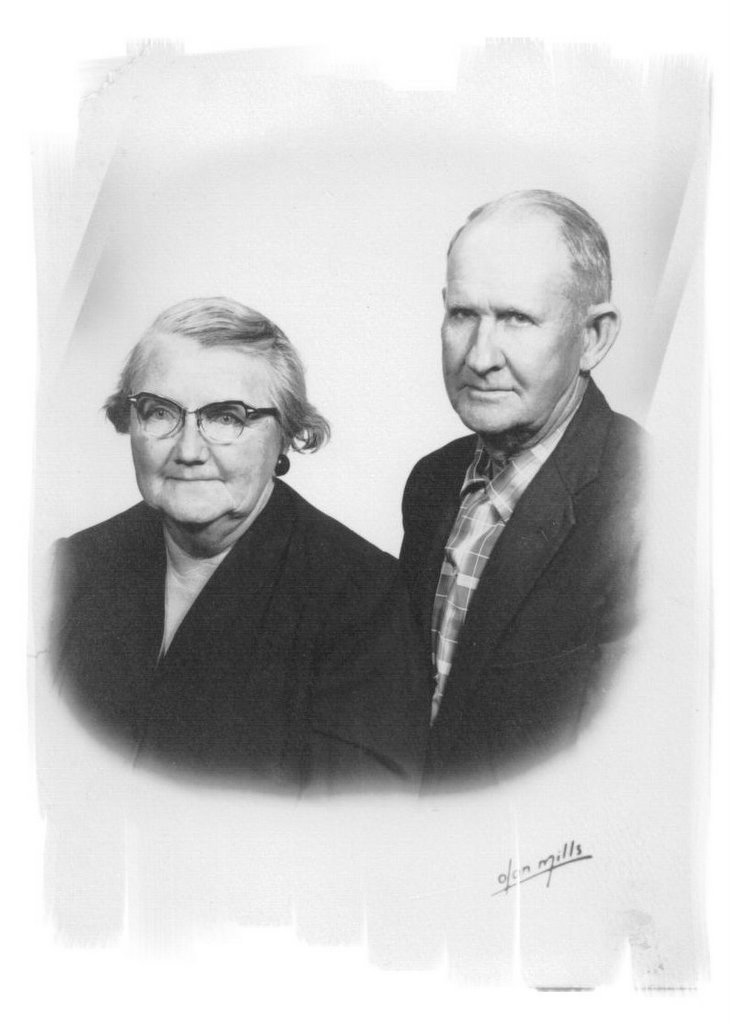
The first great influence on my life was my grandmother, Granny Atkinson, as she was known to her 20 grandchildren. Granny was my day-care provider until I started school and my after-school-care provider until I was old enough to fend for myself. To the five youngest grandchildren (myself, my brother Tracy, our three cousins Ronnie, Scott, and Steve) Granny was the axis that our world revolved around. Our parents worked in town. Granny’s house was our home from morning until night. The five of us were as close as brothers in our pre-school years and in the summers.
It amazes me when I think back to my childhood and realize just how much our world has changed in the last forty years. Granny and Granddaddy were farmers in a poor, rural, South Georgia county. They farmed 140 acres of row-crops, cows, and hogs with the help of my Uncle Junior. They lived in a four-room frame house with no indoor plumbing except for a sink in the kitchen. As I got older and saw the homes of folks in town I thought that my grandparents must have been extremely poor to have still been using an outhouse in the 1960's and 70's but as I think back, I realize that of our nine closest neighbors only four had indoor bathrooms; those four being the houses that were built in the early 60's and financed by the Farmer’s Home Administration which would not offer financing unless the home met their specifications.
Granddaddy had suffered a severe stroke when I was around two years old leaving him nearly blind and with limited hearing. When we came into the room he may confuse me for Scott or Ronnie for me, but we would walk him across the road when the cows came up to water and he could tell you exactly which cows were his and which were Uncle Junior’s. One of his favorite things was to watch wrestling on TV. He would pull his rocking chair up to within an inch or two of the old RCA black-and-white set on Saturday afternoons and watch Florida wrestling on channel 6 right after lunch and Alabama wrestling on channel 4 later in the afternoon (right after the Gene Reagan Farm Report and just before Lawrence Welk). There was never more physical activity in that house than when Granddaddy got that chair rocking as Terry Funk and Jack Briscoe or Dick Dunn and The Wrestling Pro went at it. As weak as he was, I would have pitied The Masked Yankees or their manager J. C. Dykes if W. C. Atkinson, Sr. could have gotten his hands on them.
If I were in charge of dictionary illustrations, there would be a picture of Granny Atkinson next to the entry for "saint". Granny raised seven children and most of her grandchildren, keeping the house in order, feasts on the table, and doing whatever she could on the farm. Our first real jobs was helping Granny pick up pecans. I don’t know how she persuaded five pre-school boys to help, but we did.
Every day after lunch (dinner is what we call it) Granny would lay out quilts on the floor and five boys would nap. As we napped, Granny read her bible. I don’t believe there was ever a missed day. She would underline scripture. Practically her entire bible was underlined. It would take me nearly 40 years to learn the value of daily bible reading.
In those days visiting was still a regular practice. It seemed that everyone who passed by on the road would stop for a while and visit on the front porch. Many people stopped to buy some Watkins products. The Ladies Auxiliary of Hebrew Freewill Baptist Church sold these products as a fund-raiser. Granny kept cases of Vanilla Extract and Lemon Flavoring at her house and folks would come by to get some when they needed them. She also used those flavorings in the magnificent cakes that she would bake from time to time. I would love to have one of her Lemon-Cheese cakes right now. I have the recipe, but when she wrote down the ingredients, she didn’t write down the quantities, so I have not had much luck at replicating exactly her recipe.
Granny was what we call in our church a "quiet disciple". Full of faith and humility, she quietly witnessed to her children, grandchildren and everyone she met. Several cousins and an aunt are still active members of Hebrew Freewill Baptist Church. My daddy was baptized and joined that church just weeks before he died. I am sure that Granny cried tears of joy in heaven that day, just as we did here.
The Heroes of Prevenient Grace
The Grace of our Lord finds many paths into our lives. The method most common to all is probably our conscience. Everyone has an inner awareness that tells us that some things are right and others are wrong. We also are aware that failure to do certain things or to act in certain ways is wrong.
Another pathway of grace is through our experiences. The Spirit can be seen in both good and bad experiences. We may not always recognize the workings of the Spirit at the time, but many times, looking back, we can plainly see that certain experiences point us toward God or bring us closer to dependence upon God.
But to me, the most obvious tool used by the Spirit to bring grace into our lives is through the people who influence our lives. Not only the folks that we normally consider to be Christian witnesses, but everyone who has an impact on our life.
I am going to begin with my very next post a series of essays about the people who have had a hand in making me who I am today. My heroes.
Another pathway of grace is through our experiences. The Spirit can be seen in both good and bad experiences. We may not always recognize the workings of the Spirit at the time, but many times, looking back, we can plainly see that certain experiences point us toward God or bring us closer to dependence upon God.
But to me, the most obvious tool used by the Spirit to bring grace into our lives is through the people who influence our lives. Not only the folks that we normally consider to be Christian witnesses, but everyone who has an impact on our life.
I am going to begin with my very next post a series of essays about the people who have had a hand in making me who I am today. My heroes.
Sunday School Lesson: Saying Goodbye
Purpose: To help us embrace the joy and grief of ministries completed and the anticipation of ministries to come.
Scripture: Acts 20:17-38
What are some of the events of life that you think would be the most stressful?
Psychologists have a list. It is called the Holmes-Rahe Stress Scale. This scale lists 43 common events in most people lives and places a score on each. This scale can be used to gauge the amount of stress in a person’s life at any given time.
What do you think would be the top ten?
1. Death of spouse – 100
2. Divorce – 73
3. Marital separation – 65
4. Jail term – 63
5. Death of close family – 63
6. Personal injury or illness – 53
7. Marriage – 50
8. Fired from work – 47
9. Reconciliation – 45
10. Retirement – 45
Of those in the top ten, how many relate in some way to a separation from those we love or a goodbye?
Why are goodbyes so stressful? What are some ways we can cope?
If you knew that today would be your last day with a person or group whom you love very much what would you want to tell them?
As Methodists with our itinerant preachers, this lesson may remind us of real-life goodbyes. Think about the ways that our churches say goodbye to leaving pastors as well as how we welcome new pastors. Many churches face similar situations as members are called into ministries or missions that take them away from the home-church that they know and love, but also the church that may have nurtured their faith to the point of being called into ministry.
Do we normally have some feelings of grief when we have to say goodbye to a popular pastor or loved member who leaves our fellowship to follow a call to ministry?
What about when we lose a member for some other reason? Suppose a member chooses to leave our fellowship for some reason that we may consider trivial. Do we grieve over those goodbyes?
What kind of send-off does your church give to a leaving pastor or to someone on his or her way to the mission field?
Background:
Paul had completed his third missionary journey and was making his way back to Jerusalem, wanting to reach Jerusalem in time for Pentecost. Paul wanted to visit with the elders of the church at Ephesus, but to save time he had them to meet him at Miletus, a port city approximately 30 miles from Ephesus.
Paul’s ministry in Ephesus is recorded in Acts 19. His stay in Ephesus featured both successes and failures. When Paul arrived at Ephesus he found "disciples" there who had never even heard of the Holy Spirit. Paul preached in the synagogue there until forced out by detractors. After that Paul taught the disciples for two years in a lecture hall at a local school. During this two years "all the Jews and Greeks who lived in the province of Asia heard the word of the Lord." Paul performed many miracles during this time. At the end of this time Paul decided to travel to Macedonia and Achaia, then to Jerusalem prior to going on to Rome. Before Paul left there was some rioting in the city. The riots were started by silversmiths whose profits had been declining because of the preaching of Paul. The silversmiths main product was idols of the goddess Artemis. As the people of Ephesus learned the Gospel and the dangers of idolatry, the demand for silver idolatrous ornaments was greatly lessened. The rioting may have also led to the meeting at Miletus instead of in Ephesus.
Now from Miletus he sent to Ephesus and called the elders of the church to come to him. And when they came to him, he said to them: "You yourselves know how I lived among you the whole time from the first day that I set foot in Asia, serving the Lord with all humility and with tears and with trials that happened to me through the plots of the Jews; how I did not shrink from declaring to you anything that was profitable, and teaching you in public and from house to house, testifying both to Jews and to Greeks of repentance toward God and of faith in our Lord Jesus Christ. And now, behold, I am going to Jerusalem, constrained by the Spirit, not knowing what will happen to me there, except that the Holy Spirit testifies to me in every city that imprisonment and afflictions await me. But I do not account my life of any value nor as precious to myself, if only I may finish my course and the ministry that I received from the Lord Jesus, to testify to the gospel of the grace of God.
(Act 20:17-24 ESV)
Paul says that he served "with humility and with tears". Why does serving God involve tears?
Scripture: Acts 20:17-38
What are some of the events of life that you think would be the most stressful?
Psychologists have a list. It is called the Holmes-Rahe Stress Scale. This scale lists 43 common events in most people lives and places a score on each. This scale can be used to gauge the amount of stress in a person’s life at any given time.
What do you think would be the top ten?
1. Death of spouse – 100
2. Divorce – 73
3. Marital separation – 65
4. Jail term – 63
5. Death of close family – 63
6. Personal injury or illness – 53
7. Marriage – 50
8. Fired from work – 47
9. Reconciliation – 45
10. Retirement – 45
Of those in the top ten, how many relate in some way to a separation from those we love or a goodbye?
Why are goodbyes so stressful? What are some ways we can cope?
If you knew that today would be your last day with a person or group whom you love very much what would you want to tell them?
As Methodists with our itinerant preachers, this lesson may remind us of real-life goodbyes. Think about the ways that our churches say goodbye to leaving pastors as well as how we welcome new pastors. Many churches face similar situations as members are called into ministries or missions that take them away from the home-church that they know and love, but also the church that may have nurtured their faith to the point of being called into ministry.
Do we normally have some feelings of grief when we have to say goodbye to a popular pastor or loved member who leaves our fellowship to follow a call to ministry?
What about when we lose a member for some other reason? Suppose a member chooses to leave our fellowship for some reason that we may consider trivial. Do we grieve over those goodbyes?
What kind of send-off does your church give to a leaving pastor or to someone on his or her way to the mission field?
Background:
Paul had completed his third missionary journey and was making his way back to Jerusalem, wanting to reach Jerusalem in time for Pentecost. Paul wanted to visit with the elders of the church at Ephesus, but to save time he had them to meet him at Miletus, a port city approximately 30 miles from Ephesus.
Paul’s ministry in Ephesus is recorded in Acts 19. His stay in Ephesus featured both successes and failures. When Paul arrived at Ephesus he found "disciples" there who had never even heard of the Holy Spirit. Paul preached in the synagogue there until forced out by detractors. After that Paul taught the disciples for two years in a lecture hall at a local school. During this two years "all the Jews and Greeks who lived in the province of Asia heard the word of the Lord." Paul performed many miracles during this time. At the end of this time Paul decided to travel to Macedonia and Achaia, then to Jerusalem prior to going on to Rome. Before Paul left there was some rioting in the city. The riots were started by silversmiths whose profits had been declining because of the preaching of Paul. The silversmiths main product was idols of the goddess Artemis. As the people of Ephesus learned the Gospel and the dangers of idolatry, the demand for silver idolatrous ornaments was greatly lessened. The rioting may have also led to the meeting at Miletus instead of in Ephesus.
Now from Miletus he sent to Ephesus and called the elders of the church to come to him. And when they came to him, he said to them: "You yourselves know how I lived among you the whole time from the first day that I set foot in Asia, serving the Lord with all humility and with tears and with trials that happened to me through the plots of the Jews; how I did not shrink from declaring to you anything that was profitable, and teaching you in public and from house to house, testifying both to Jews and to Greeks of repentance toward God and of faith in our Lord Jesus Christ. And now, behold, I am going to Jerusalem, constrained by the Spirit, not knowing what will happen to me there, except that the Holy Spirit testifies to me in every city that imprisonment and afflictions await me. But I do not account my life of any value nor as precious to myself, if only I may finish my course and the ministry that I received from the Lord Jesus, to testify to the gospel of the grace of God.
(Act 20:17-24 ESV)
Paul says that he served "with humility and with tears". Why does serving God involve tears?
Several things about this speech from Paul stand out:
- This is the only example in Acts of Paul’s pastoral teaching to Christians. All other speeches in Acts were evangelical speeches given to non-believers.
- Due to the nature of the audience, this is one of few speeches given to a totally friendly crowd. The non-believing crowds ranged from keenly interested to greatly offended.
- This speech is amazingly consistent with the content of Paul’s epistles. Luke makes no mention of the epistles in Acts. Some similarities between this speech and the epistles are: Paul acknowledged the criticism he received from the church; suffering that he had experienced; his concern for the poor and needy; the fact that he had been self-supporting through his trade of tentmaking.
- This speech also has parallels to the final words of Jesus to the disciples as recorded in Luke and John: they will soon be separated; they will experience sorrow due to this separation; God’s Word and the Holy Spirit will them to carry on; they will experience problems from within and without; they both predicted their own future suffering; they both blessed those gathered around for their farewell.
From The New International Lesson Annual ed. by Nan Duerling:
When a pastor leaves a flock, there is always a momentary concern: Will there be faithful leadership for the congregation? Whether a new pastor arrives immediately or a lengthy delay separates the time between pastors, congregations are equipped with leaders. Frequently these leaders have a blessed opportunity to receive their new responsibilities and authority directly. That’s what happens in this farewell speech: Paul hands over responsibility and authority to the elders from Ephesus. This transformation is graceful, yet firm. Grace abounds as Paul acknowledges the spiritual maturity of the leaders. Have you ever noticed the tendency of contemporary leaders to notice their (elders) deficits rather than their attributes? Imagine having a beloved pastor shaking your hand while saying, "I’ve shared the whole purpose of God with you!" Surely, such knowledge is sufficient for the leadership challenges ahead.
And now, behold, I know that none of you among whom I have gone about proclaiming the kingdom will see my face again. Therefore I testify to you this day that I am innocent of the blood of all of you, for I did not shrink from declaring to you the whole counsel of God. Pay careful attention to yourselves and to all the flock, in which the Holy Spirit has made you overseers, to care for the church of God, which he obtained with his own blood.
(Act 20:25-28 ESV)
And when he had said these things, he knelt down and prayed with them all. And there was much weeping on the part of all; they embraced Paul and kissed him, being sorrowful most of all because of the word he had spoken, that they would not see his face again. And they accompanied him to the ship.
(Act 20:36-38 ESV)
What most saddened the group of elders?
How did they display their love for Paul?
Then Paul went down on his knees, all of them kneeling with him, and prayed. And then a river of tears. Much clinging to Paul, not wanting to let him go. They knew they would never see him again--he had told them quite plainly. The pain cut deep. Then, bravely, they walked him down to the ship.
(Act 20:36-38 MSG)
From the "Wesleyan Christian Advocate":
Paul’s closing act of ministry with the Ephesian church was to kneel and pray for the people who came to be with him. They embraced Paul, and Paul embraced them. They Ephesians wanted Paul to feel their love and support for him in the future, and Paul wanted them to know of his continued love and concern as they carried on the ministry of Jesus Christ.
"They walked him down to the ship" (Acts 20:38, The Message). One can imagine that long after they could hear the shouts of farewell as the ship moved away from the port, there must have been hand waves shared until they could only see a speck of the ship moving completely out of sight. All that remained were the memories of times shared together and feelings that each one cherished. Those gifts were blessings that would continue to empower the church and the people of Ephesus.
Wednesday, November 16, 2005
Sunday, November 13, 2005
What’s So Amazing About Grace- Week 14 - Loopholes
What is a Christian?
How would you define “Christian”?
From John Wesley’s “A Plain Account of Genuine Christianity” (1753)
“Who is a Christian indeed? What does that term properly imply? It has been so long abused, I fear (it means) nothing at all....”
What is required to claim the name “Christian”?
Is faith all that is required? I’ve said the sinners prayer. I’ve been baptized. Am I done? Can I continue with life as usual?
Our discussion to this point has centered on the radical nature of grace. Grace is available to all. Regardless of past sins, forgiveness and grace is ours. No matter how much of an oddball we are.
Can we abuse grace?
What would result from “grace abuse”?
For certain people have crept in unnoticed who long ago were designated for this condemnation, ungodly people, who pervert the grace of our God into sensuality and deny our only Master and Lord, Jesus Christ.
(Jud 1:4 ESV)
What shall we say then? Are we to continue in sin that grace may abound? By no means! How can we who died to sin still live in it? Do you not know that all of us who have been baptized into Christ Jesus were baptized into his death? We were buried therefore with him by baptism into death, in order that, just as Christ was raised from the dead by the glory of the Father, we too might walk in newness of life.
(Rom 6:1-4 ESV)
What would the end result be if we continued knowingly, unrepentantly, sinning after experiencing the justifying grace of Christ?
so that at the name of Jesus every knee should bow, in heaven and on earth and under the earth, and every tongue confess that Jesus Christ is Lord, to the glory of God the Father. Therefore, my beloved, as you have always obeyed, so now, not only as in my presence but much more in my absence, work out your own salvation with fear and trembling, for it is God who works in you, both to will and to work for his good pleasure. Do all things without grumbling or questioning, that you may be blameless and innocent, children of God without blemish in the midst of a crooked and twisted generation, among whom you shine as lights in the world, holding fast to the word of life, so that in the day of Christ I may be proud that I did not run in vain or labor in vain.
(Phi 2:10-16 ESV)
This is the message we have heard from him and proclaim to you, that God is light, and in him is no darkness at all. If we say we have fellowship with him while we walk in darkness, we lie and do not practice the truth. But if we walk in the light, as he is in the light, we have fellowship with one another, and the blood of Jesus his Son cleanses us from all sin. If we say we have no sin, we deceive ourselves, and the truth is not in us. If we confess our sins, he is faithful and just to forgive us our sins and to cleanse us from all unrighteousness. If we say we have not sinned, we make him a liar, and his word is not in us.
(1Jo 1:5-10 ESV)
What does it mean to be “born again”?
Excerpts from John Wesley’s Sermon #18, “The Marks of the New Birth”:
“How is every one that is "born of the Spirit," -- that is, born again, -- born of God? What is meant by the being born again, the being born of God, or being born of the Spirit? What is implied in the being a son or a child of God, or having the Spirit of adoption? That these privileges, by the free mercy of God, are ordinarily annexed to baptism (which is thence termed by our Lord in a preceding verse, the being "born of water and of the Spirit") we know; but we would know what these privileges are: What is the new birth?”
From Wesley’s Sermon #45, “The New Birth”:
“Before a child is born into the world he has eyes, but sees not; he has ears, but does not hear. He has a very imperfect use of any other sense. He has no knowledge of any of the things of the world, or any natural understanding. To that manner of existence which he then has, we do not even give the name of life. It is then only when a man is born, that we say he begins to live. For as soon as he is born, be begins to see the light, and the various objects with which he is encompassed. His ears are then opened, and he hears the sounds which successively strike upon them. At the same time, all the other organs of sense begin to be exercised upon their proper objects. He likewise breathes, and lives in a manner wholly different from what he did before. How exactly doth the parallel hold in all these instances! While a man is in a mere natural state, before he is born of God, he has, in a spiritual sense, eyes and sees not; a thick impenetrable veil lies upon them; he has ears, but hears not; he is utterly deaf to what he is most of all concerned to hear. His other spiritual senses are all locked up: He is in the same condition as if he had them not. Hence he has no knowledge of God; no intercourse with him; he is not at all acquainted with him. He has no true knowledge of the things of God, either of spiritual or eternal things; therefore, though he is a living man, he is a dead Christian. But as soon as he is born of God, there is a total change in all these particulars. The "eyes of his understanding are opened;" (such is the language of the great Apostle;) and, He who of old "commanded light to shine out of darkness shining on his heart, he sees the light of the glory of God," his glorious love, "in the face of Jesus Christ." His ears being opened, he is now capable of hearing the inward voice of God, saying, "Be of good cheer; thy sins are forgiven thee;" "go and sin no more."”
From hence it manifestly appears, what is the nature of the new birth. It is that great change which God works in the soul when he brings it into life; when he raises it from the death of sin to the life of righteousness. It is the change wrought in the whole soul by the almighty Spirit of God when it is "created anew in Christ Jesus;" when it is "renewed after the image of God, in righteousness and true holiness;" when the love of the world is changed into the love of God; pride into humility; passion into meekness; hatred, envy, malice, into a sincere, tender, disinterested love for all mankind. In a word, it is that change whereby the earthly, sensual, devilish mind is turned into the "mind which was in Christ Jesus." This is the nature of the new birth: "So is every one that is born of the Spirit."
So if, regardless of any profession of faith, there is no obvious sign of a “new birth” can we say that one is not really “born-again”?
Ok, so a Christian is “born-again” and shows some sign of rebirth.
Then what is a disciple?
Is there a difference between a “Christian” and a “disciple”?
Will a disciple receive greater rewards than a mere Christian?
What can we say about someone who abuses grace? Has that person truly experienced grace?
How can we remain in the area between offering grace and being judgmental?
This is Jesus’ conclusion to the Sermon on the Mount:
"Beware of false prophets, who come to you in sheep's clothing but inwardly are ravenous wolves. You will recognize them by their fruits. Are grapes gathered from thornbushes, or figs from thistles? So, every healthy tree bears good fruit, but the diseased tree bears bad fruit. A healthy tree cannot bear bad fruit, nor can a diseased tree bear good fruit. Every tree that does not bear good fruit is cut down and thrown into the fire. Thus you will recognize them by their fruits. "Not everyone who says to me, 'Lord, Lord,' will enter the kingdom of heaven, but the one who does the will of my Father who is in heaven. On that day many will say to me, 'Lord, Lord, did we not prophesy in your name, and cast out demons in your name, and do many mighty works in your name?' And then will I declare to them, 'I never knew you; depart from me, you workers of lawlessness.' "Everyone then who hears these words of mine and does them will be like a wise man who built his house on the rock. And the rain fell, and the floods came, and the winds blew and beat on that house, but it did not fall, because it had been founded on the rock. And everyone who hears these words of mine and does not do them will be like a foolish man who built his house on the sand. And the rain fell, and the floods came, and the winds blew and beat against that house, and it fell, and great was the fall of it."
(Mat 7:15-27 ESV)
See what kind of love the Father has given to us, that we should be called children of God; and so we are. The reason why the world does not know us is that it did not know him. Beloved, we are God's children now, and what we will be has not yet appeared; but we know that when he appears we shall be like him, because we shall see him as he is. And everyone who thus hopes in him purifies himself as he is pure. Everyone who makes a practice of sinning also practices lawlessness; sin is lawlessness. You know that he appeared to take away sins, and in him there is no sin. No one who abides in him keeps on sinning; no one who keeps on sinning has either seen him or known him. Little children, let no one deceive you. Whoever practices righteousness is righteous, as he is righteous. Whoever makes a practice of sinning is of the devil, for the devil has been sinning from the beginning. The reason the Son of God appeared was to destroy the works of the devil. No one born of God makes a practice of sinning, for God's seed abides in him, and he cannot keep on sinning because he has been born of God. By this it is evident who are the children of God, and who are the children of the devil: whoever does not practice righteousness is not of God, nor is the one who does not love his brother.
(1Jo 3:1-10 ESV)
Excerpts from Dietrich Bonhoeffer’s The Cost of Discipleship:
“Cheap grace is the deadly enemy of our church. We are fighting today for costly grace...
Cheap grace means grace as a doctrine, a principle, a system. It means forgiveness of sins proclaimed as a general truth, the love of God taught as the Christian “conception” of God. An intellectual assent to that idea is held to be of itself sufficient to secure the remission of sins...
Cheap grace means the justification of the sin without the justification of the sinner. Grace alon does everything, they say, and so everything can remain as it was before...
Cheap grace is not the kind of forgiveness of sin which frees us from the toils of sin. Cheap grace is the grace we bestow on ourselves.
Cheap grace is the preaching of forgiveness without requiring repentance, baptism without church discipline. Communion without confession, absolution without personal confession. Cheap grace is grace without discipleship, grace without the cross, grace without Jesus Christ, living and incarnate...”
How would you define “Christian”?
From John Wesley’s “A Plain Account of Genuine Christianity” (1753)
“Who is a Christian indeed? What does that term properly imply? It has been so long abused, I fear (it means) nothing at all....”
What is required to claim the name “Christian”?
Is faith all that is required? I’ve said the sinners prayer. I’ve been baptized. Am I done? Can I continue with life as usual?
Our discussion to this point has centered on the radical nature of grace. Grace is available to all. Regardless of past sins, forgiveness and grace is ours. No matter how much of an oddball we are.
Can we abuse grace?
What would result from “grace abuse”?
For certain people have crept in unnoticed who long ago were designated for this condemnation, ungodly people, who pervert the grace of our God into sensuality and deny our only Master and Lord, Jesus Christ.
(Jud 1:4 ESV)
What shall we say then? Are we to continue in sin that grace may abound? By no means! How can we who died to sin still live in it? Do you not know that all of us who have been baptized into Christ Jesus were baptized into his death? We were buried therefore with him by baptism into death, in order that, just as Christ was raised from the dead by the glory of the Father, we too might walk in newness of life.
(Rom 6:1-4 ESV)
What would the end result be if we continued knowingly, unrepentantly, sinning after experiencing the justifying grace of Christ?
so that at the name of Jesus every knee should bow, in heaven and on earth and under the earth, and every tongue confess that Jesus Christ is Lord, to the glory of God the Father. Therefore, my beloved, as you have always obeyed, so now, not only as in my presence but much more in my absence, work out your own salvation with fear and trembling, for it is God who works in you, both to will and to work for his good pleasure. Do all things without grumbling or questioning, that you may be blameless and innocent, children of God without blemish in the midst of a crooked and twisted generation, among whom you shine as lights in the world, holding fast to the word of life, so that in the day of Christ I may be proud that I did not run in vain or labor in vain.
(Phi 2:10-16 ESV)
This is the message we have heard from him and proclaim to you, that God is light, and in him is no darkness at all. If we say we have fellowship with him while we walk in darkness, we lie and do not practice the truth. But if we walk in the light, as he is in the light, we have fellowship with one another, and the blood of Jesus his Son cleanses us from all sin. If we say we have no sin, we deceive ourselves, and the truth is not in us. If we confess our sins, he is faithful and just to forgive us our sins and to cleanse us from all unrighteousness. If we say we have not sinned, we make him a liar, and his word is not in us.
(1Jo 1:5-10 ESV)
What does it mean to be “born again”?
Excerpts from John Wesley’s Sermon #18, “The Marks of the New Birth”:
“How is every one that is "born of the Spirit," -- that is, born again, -- born of God? What is meant by the being born again, the being born of God, or being born of the Spirit? What is implied in the being a son or a child of God, or having the Spirit of adoption? That these privileges, by the free mercy of God, are ordinarily annexed to baptism (which is thence termed by our Lord in a preceding verse, the being "born of water and of the Spirit") we know; but we would know what these privileges are: What is the new birth?”
From Wesley’s Sermon #45, “The New Birth”:
“Before a child is born into the world he has eyes, but sees not; he has ears, but does not hear. He has a very imperfect use of any other sense. He has no knowledge of any of the things of the world, or any natural understanding. To that manner of existence which he then has, we do not even give the name of life. It is then only when a man is born, that we say he begins to live. For as soon as he is born, be begins to see the light, and the various objects with which he is encompassed. His ears are then opened, and he hears the sounds which successively strike upon them. At the same time, all the other organs of sense begin to be exercised upon their proper objects. He likewise breathes, and lives in a manner wholly different from what he did before. How exactly doth the parallel hold in all these instances! While a man is in a mere natural state, before he is born of God, he has, in a spiritual sense, eyes and sees not; a thick impenetrable veil lies upon them; he has ears, but hears not; he is utterly deaf to what he is most of all concerned to hear. His other spiritual senses are all locked up: He is in the same condition as if he had them not. Hence he has no knowledge of God; no intercourse with him; he is not at all acquainted with him. He has no true knowledge of the things of God, either of spiritual or eternal things; therefore, though he is a living man, he is a dead Christian. But as soon as he is born of God, there is a total change in all these particulars. The "eyes of his understanding are opened;" (such is the language of the great Apostle;) and, He who of old "commanded light to shine out of darkness shining on his heart, he sees the light of the glory of God," his glorious love, "in the face of Jesus Christ." His ears being opened, he is now capable of hearing the inward voice of God, saying, "Be of good cheer; thy sins are forgiven thee;" "go and sin no more."”
From hence it manifestly appears, what is the nature of the new birth. It is that great change which God works in the soul when he brings it into life; when he raises it from the death of sin to the life of righteousness. It is the change wrought in the whole soul by the almighty Spirit of God when it is "created anew in Christ Jesus;" when it is "renewed after the image of God, in righteousness and true holiness;" when the love of the world is changed into the love of God; pride into humility; passion into meekness; hatred, envy, malice, into a sincere, tender, disinterested love for all mankind. In a word, it is that change whereby the earthly, sensual, devilish mind is turned into the "mind which was in Christ Jesus." This is the nature of the new birth: "So is every one that is born of the Spirit."
So if, regardless of any profession of faith, there is no obvious sign of a “new birth” can we say that one is not really “born-again”?
Ok, so a Christian is “born-again” and shows some sign of rebirth.
Then what is a disciple?
Is there a difference between a “Christian” and a “disciple”?
Will a disciple receive greater rewards than a mere Christian?
What can we say about someone who abuses grace? Has that person truly experienced grace?
How can we remain in the area between offering grace and being judgmental?
This is Jesus’ conclusion to the Sermon on the Mount:
"Beware of false prophets, who come to you in sheep's clothing but inwardly are ravenous wolves. You will recognize them by their fruits. Are grapes gathered from thornbushes, or figs from thistles? So, every healthy tree bears good fruit, but the diseased tree bears bad fruit. A healthy tree cannot bear bad fruit, nor can a diseased tree bear good fruit. Every tree that does not bear good fruit is cut down and thrown into the fire. Thus you will recognize them by their fruits. "Not everyone who says to me, 'Lord, Lord,' will enter the kingdom of heaven, but the one who does the will of my Father who is in heaven. On that day many will say to me, 'Lord, Lord, did we not prophesy in your name, and cast out demons in your name, and do many mighty works in your name?' And then will I declare to them, 'I never knew you; depart from me, you workers of lawlessness.' "Everyone then who hears these words of mine and does them will be like a wise man who built his house on the rock. And the rain fell, and the floods came, and the winds blew and beat on that house, but it did not fall, because it had been founded on the rock. And everyone who hears these words of mine and does not do them will be like a foolish man who built his house on the sand. And the rain fell, and the floods came, and the winds blew and beat against that house, and it fell, and great was the fall of it."
(Mat 7:15-27 ESV)
See what kind of love the Father has given to us, that we should be called children of God; and so we are. The reason why the world does not know us is that it did not know him. Beloved, we are God's children now, and what we will be has not yet appeared; but we know that when he appears we shall be like him, because we shall see him as he is. And everyone who thus hopes in him purifies himself as he is pure. Everyone who makes a practice of sinning also practices lawlessness; sin is lawlessness. You know that he appeared to take away sins, and in him there is no sin. No one who abides in him keeps on sinning; no one who keeps on sinning has either seen him or known him. Little children, let no one deceive you. Whoever practices righteousness is righteous, as he is righteous. Whoever makes a practice of sinning is of the devil, for the devil has been sinning from the beginning. The reason the Son of God appeared was to destroy the works of the devil. No one born of God makes a practice of sinning, for God's seed abides in him, and he cannot keep on sinning because he has been born of God. By this it is evident who are the children of God, and who are the children of the devil: whoever does not practice righteousness is not of God, nor is the one who does not love his brother.
(1Jo 3:1-10 ESV)
Excerpts from Dietrich Bonhoeffer’s The Cost of Discipleship:
“Cheap grace is the deadly enemy of our church. We are fighting today for costly grace...
Cheap grace means grace as a doctrine, a principle, a system. It means forgiveness of sins proclaimed as a general truth, the love of God taught as the Christian “conception” of God. An intellectual assent to that idea is held to be of itself sufficient to secure the remission of sins...
Cheap grace means the justification of the sin without the justification of the sinner. Grace alon does everything, they say, and so everything can remain as it was before...
Cheap grace is not the kind of forgiveness of sin which frees us from the toils of sin. Cheap grace is the grace we bestow on ourselves.
Cheap grace is the preaching of forgiveness without requiring repentance, baptism without church discipline. Communion without confession, absolution without personal confession. Cheap grace is grace without discipleship, grace without the cross, grace without Jesus Christ, living and incarnate...”
Saturday, November 12, 2005
Sunday School Lesson: Offering of Oneself
Purpose: To consider ways we can offer hospitality and service to others in the same spirit that Lydia and Paul demonstrated.
Scripture: Acts 16:6-15
Does God ever block us from ministry or in any way keep us from ministry?
Have any of you had an experience of the Holy Spirit forbidding you from some type of ministry?
How do we normally deal with closed doors?
And they went through the region of Phrygia and Galatia, having been forbidden by the Holy Spirit to speak the word in Asia. And when they had come up to Mysia, they attempted to go into Bithynia, but the Spirit of Jesus did not allow them. So, passing by Mysia, they went down to Troas. And a vision appeared to Paul in the night: a man of Macedonia was standing there, urging him and saying, "Come over to Macedonia and help us." And when Paul had seen the vision, immediately we sought to go on into Macedonia, concluding that God had called us to preach the gospel to them. So, setting sail from Troas, we made a direct voyage to Samothrace, and the following day to Neapolis, and from there to Philippi, which is a leading city of the district of Macedonia and a Roman colony. We remained in this city some days. And on the Sabbath day we went outside the gate to the riverside, where we supposed there was a place of prayer, and we sat down and spoke to the women who had come together. One who heard us was a woman named Lydia, from the city of Thyatira, a seller of purple goods, who was a worshiper of God. The Lord opened her heart to pay attention to what was said by Paul. And after she was baptized, and her household as well, she urged us, saying, "If you have judged me to be faithful to the Lord, come to my house and stay." And she prevailed upon us.
(Act 16:6-15)
Our lessons this quarter have all come from the book of Acts. We have seen a steady progression of the infant church beginning with the day of Pentecost and with the growth of the church following exactly as the last words of Christ told. The last recorded words of Christ immediately prior to the Ascension are recorded in Acts 1:8:
But you will receive power when the Holy Spirit has come upon you, and you will be my witnesses in Jerusalem and in all Judea and Samaria, and to the end of the earth."
(Act 1:8 ESV)
The rest of the book of Acts is a testament that what He said is exactly what happened. The Holy Spirit came upon the Apostles on the day of Pentecost. After that a loving and sharing Christian community grew in Jerusalem. As the Church in Jerusalem grew, so grew opposition to the Church. This opposition resorted to violence and murder of Christian faithful. As a result of the persecution the believers left Jerusalem, but did not leave the Faith. The saints who fled Jerusalem first carried their faith into the surrounding countryside and into Samaria. The persecutors followed. Who would have ever guessed that Christ would choose the chief persecutor to become the missionary who would take the Gospel to the end of the earth.
Last week we learned of Saul’s experience on the road to capture and punish Christians. Following his visit with Spirit of Christ, Saul becomes Paul, the missionary to the Gentiles. This weeks lesson skips forward to Paul’s second missionary journey.
On Paul’s first journey, he and Barnabas had carried the Message to Cyprus and various cities of Pamphylia, Pisidia, Galatia, and Lycaonia; all in what is modern day Turkey. After the first journey, they returned to Jerusalem to report of their success as well as to take part in the Jerusalem Council, which decided that Gentiles did not have to become Jews to be Christians. After the Council Paul invited Barnabas to return with him to the cities that they visited on the first journey. After a disagreement Paul leaves with Silas for Syria and Cilicia, while Barnabas and Mark go to Cyprus.
In Lystra, a city on Lycaonia, Paul and Silas are joined by Timothy. And that brings us up to this weeks scripture lesson.
Verse 6 says that they were forbidden by the Spirit to speak the Word in Asia. What exactly does it mean to be forbidden by the Spirit?
How do you think the Spirit communicated this command to the missionaries?
If any of you have ever experienced the Spirit moving you away from a certain ministry, share with us how that was communicated to you?
Why would the Holy Spirit want to keep the Word from any place? Don’t you think that God wants the Gospel taken everywhere?
Verse 7 says that they attempted to enter Bithynia which is in the area that at that time was called Asia. If they had already been told by the Spirit not to go to Asia, why do you think they tried anyway?
How do you think they were stopped from entering Bithynia?
When we are "called" to NOT do something, should our response be the same as when we are called to DO something?
What should that response be?
When our intended course is blocked by God, what are some potential courses of action?
Should we stop and pray and wait for further guidance or just keep on plodding forward? Which is the better course of action?
We should always remember that just because one door was closed, there may be others opened.
Which do you think is easier, being led away from doing something or being led to do something?
After their failed attempt to enter Asia, Paul has a vision. A man from Macedonia pleads with him in this vision to come over to Macedonia. How does Paul respond to this call?
Is this how we normally respond to God’s calls? Immediately getting up and going?
Why do you think Paul responded quicker to the call to "go" than he had to the call to "stay away"?
How can we make ourselves more receptive to the guidance of the Spirit?
Even our best plans may not be God’s plan. We must always listen and be open to the idea that God may direct us in a way that we are not planning on. What are some potential problems that we may face when we assume that our plans are God’s plans?
Does doing God’s will preclude difficult experiences or hard work?
Just because we face difficulty in our ministry does not mean that God is redirecting us. So, what "voice" does God use to indicate His will?
How do we know the "voice" is God’s voice?
Notice the change in tense from verse 10 to verse 11. This begins one of the "we" passages in Acts. Scholars cannot agree on why these passages are in Acts. Some believe that Luke accompanied Paul on portions of his journeys. Some believe that Luke may have had access to Paul’s or Silas’s journals and copied portions directly from them. One commentary that I read even suggested that Luke may have been from Philippi and may have been the man in the vision calling Paul to his city. Regardless, Paul and his companions sail to Macedonia and the city of Philippi and spend some time there.
What do we know about Philippi? Philippi was an important city "an leading city in the district of Macedonia and a Roman colony." Philippi was named after the father of Alexander the Great. The Romans placed "colony" cities at strategic locations throughout the Empire. Retired soldiers were encouraged to live in the colony cities by being exempt from taxes. These colonies of Roman citizens helped maintain stability in regions remote from Rome.
What was Paul’s normal course of action once he entered a new town?
He normally went and shared his message at the local synagogue.
But what does he do at Philippi?
He went to a place of prayer next to the river.
This indicates that there may not have been enough of a Jewish population at Philippi to warrant a synagogue. Also note that verse 13 says that they spoke to women gathered there. Jewish law required at least ten men in a community to form a synagogue. Their law would not allow an all female synagogue. The first century Jewish attitudes toward women make Paul’s willingness to teach them worth noting. Remember that Paul was a Pharisee and was taught the law his whole life. Yet Paul’s grasp of grace seems to be greater than that of those who lived with Jesus during His years of ministry. Paul sat and taught the women. The seated position was the traditional rabbinical teaching position. These women had an unofficial synagogue on the banks of the river with Paul as Rabbi.
The description of Lydia as a worshiper of God could have meant several things: she could have been born Jewish, a convert to Judaism, or a God-fearing Gentile like Cornelius in the lesson from October 23. She was not a Christian until she had the rebirth experience that is described in today’s scripture.
How many "God-fearers" do you think there are in the world who have not had their hearts opened to the gospel and taken that step toward becoming part of the Body of Christ?
How many in our community?
How should we reach out to these people?
What was Lydia’s response to this experience of grace that she had?
Is hospitality and a desire for fellowship a common response to the Gospel?
John Wesley would have thought that it was a necessary response.
These are some highlights from Wesley’s "A Plain Account of Genuine Christianity":
Who is a Christian...? What does that term properly imply?...
....remembering that God is love, he is conformed to the same likeness. He is full of love to his neighbor: of universal love....
His love to these, so to all mankind, is in itself generous and disinterested...
And this universal, disinterested love is productive of all right affective...It makes a Christian rejoice in the virtues of all, and bear a part in their happiness at the same time that he sympathizes with their pains and compassionates their infirmities...
Wesley lays out 15 paragraphs of descriptive commentary on Christian character. From the concluding paragraph:
This is the plain, naked portraiture of a Christian.....
Is it your own? Away with names! Away with opinions! I care not what you are called....
Do you not know that you ought to be such?...
Do you at least desire it? I would to God that desire may penetrate you inmost soul and that you are not only almost but altogether a Christian.
According to Wesley (and evidenced in Lydia’s example) one sure sign of a born-again Christian is a love for others and a desire for fellowship. In what ways can Lydia’s example challenge and encourage us?
What are some ministries of our church that are for the sole purpose of hospitality and service?
Lydia was a faithful worker, a servant, and an example for us all. She not only opened her heart to the Holy Spirit, but opened her home for the use of God’s people.
From the Wesleyan Christian Advocate, "Offering of Oneself", by Mac and Vicki Brantley, Nov. 4, 2005:
Hospitality gives a person the opportunity to be the hands, feet, and voice of Christ to those in our midst. Hospitality is an avenue of humility. It allows us to place another person before ourselves and to care for other’s needs. Like other expressions of Christ, the hospitable one receives as much or more than the person being helped...
This fall, many United Methodist congregations have taken the opportunity of helping countless persons from the Gulf Coast who were devastated by hurricanes Katrina and Rita. Evacuees have been blessed by the generosity and services that they have found in their new living quarters. Strangers have been blessed by individuals and churches that opened their doors and hearts to show their care. In an effort to care for others, many churches have been blessed by reaching out to others. But that’s what the church is all about.
Bishop Janice Huie challenged the churches of the Texas Annual Conference to turn their houses of worship into disciple-making homes. She stated that this transformation begins with radical hospitality. Here is how she described it:
"The first movement of disciple-making is radical hospitality. A hospitality that reaches across economic, racial, age, and gender lines. A hospitality that focuses on the stranger and those outside the community of faith. A hospitality that reaches people who don’t look or act like us. A hospitality that ministers to children not its own. A congregation making disciples of Jesus Christ for the transformation of the world is a congregation actively engaged in radical hospitality."
"Let us for each other care, each the other’s burdens to bear; to thy church the pattern give, show how true believers live" (Hymn 562, verse 4, UMH)
Monday, November 07, 2005
Hymn of the Week
hymn
(pr.: ‘him) noun
1: a song of praise to God
2: a song of praise or joy
“There’s no such thing as Christian music. There are just Christian lyrics...” Rick Warren in The Purpose Driven Life

"Return of the Revolution" by the O. C. Supertones from the album Loud and Clear
There ain’t no stopping us now
I’d like to say that from the outset
Not up in this business just to get what we can get
But bet that
We gonna bring it to you loud and clear
How loud
I gotta say it ’fore you people start to hear
I can name our problems
But I know a solution
Bring back the revolution.
The revolution comes and we all stand as on
Rises from the darkness and shines like the sun
As the sun gets higher, our church catches fire
Down from our pride and up from the mire.
It’s a dream that I’ve had and I hope it comes true
I forgot to say the revolution starts with you.
See wisdom and knowledge is one thing that we lack
You’ve been a christian how long and you’re still on similac
So I call on martin luther and all the reformation back
Then the common people couldn’t read god’s revelation
You had to be a monk or a priest or read latin
That was all before the revolution happened
But the fire cooled down ever since that generation
We put down the Bible and pick up the play station
And we can’t defend our faith ’cause we don’t even know it
We say we love his word but pick a funny way to show it.
The world walks by and we don’t have a thing to say
I call ’em as I see ’em
And that’s what I see today
Chorus:
The revolution returns
The reformation lives on
The great awakening is now
Sleepers open your eyes
A war is on, our rally cry is no compromise
No compromise, yeah, no compromise
A war is on, our battle cry is no compromise
So throw your fist up and pray the revolution rise
A war is on, our rally cry is no compromise
Our hearts have grown so cold
And we’ve such numb souls
But shirts and bumper stickers
Man we got ’em by the truckload
Is true religion what you have around your wrist
What does the scripture say of this
They honor me with words
But their hearts are far away
I call ’em like I see ’em
And that’s what I see today
So I call on john edwards
Who preched us all awake
We try to be emotional but here is our mistake
As a church we lack repentance and we lack true affection
Not only in our minds but our hearts need correction
And man that’s true religion, resignation and contrition
To love each other so much that we’d die before division
(chorus)
So what about you
Will you join us
Will you admit that the waters around us have grown
You better start swimming or you’ll sink like a stone
Do you stand with us or do we stand alone
It’s time that we stand up, enlist for the war
I’ve tasted battle and now I want moreI
’ve known the truth and been cut to the core
But I’m back in the game to even the score
And I mean to go out with both my guns blazing
Amazed at a God who’s so truly amazing
To triumph in battle as the spirit enables
Can’t turn back the clock but we can turn the tables
(pr.: ‘him) noun
1: a song of praise to God
2: a song of praise or joy
“There’s no such thing as Christian music. There are just Christian lyrics...” Rick Warren in The Purpose Driven Life
"Return of the Revolution" by the O. C. Supertones from the album Loud and Clear
There ain’t no stopping us now
I’d like to say that from the outset
Not up in this business just to get what we can get
But bet that
We gonna bring it to you loud and clear
How loud
I gotta say it ’fore you people start to hear
I can name our problems
But I know a solution
Bring back the revolution.
The revolution comes and we all stand as on
Rises from the darkness and shines like the sun
As the sun gets higher, our church catches fire
Down from our pride and up from the mire.
It’s a dream that I’ve had and I hope it comes true
I forgot to say the revolution starts with you.
See wisdom and knowledge is one thing that we lack
You’ve been a christian how long and you’re still on similac
So I call on martin luther and all the reformation back
Then the common people couldn’t read god’s revelation
You had to be a monk or a priest or read latin
That was all before the revolution happened
But the fire cooled down ever since that generation
We put down the Bible and pick up the play station
And we can’t defend our faith ’cause we don’t even know it
We say we love his word but pick a funny way to show it.
The world walks by and we don’t have a thing to say
I call ’em as I see ’em
And that’s what I see today
Chorus:
The revolution returns
The reformation lives on
The great awakening is now
Sleepers open your eyes
A war is on, our rally cry is no compromise
No compromise, yeah, no compromise
A war is on, our battle cry is no compromise
So throw your fist up and pray the revolution rise
A war is on, our rally cry is no compromise
Our hearts have grown so cold
And we’ve such numb souls
But shirts and bumper stickers
Man we got ’em by the truckload
Is true religion what you have around your wrist
What does the scripture say of this
They honor me with words
But their hearts are far away
I call ’em like I see ’em
And that’s what I see today
So I call on john edwards
Who preched us all awake
We try to be emotional but here is our mistake
As a church we lack repentance and we lack true affection
Not only in our minds but our hearts need correction
And man that’s true religion, resignation and contrition
To love each other so much that we’d die before division
(chorus)
So what about you
Will you join us
Will you admit that the waters around us have grown
You better start swimming or you’ll sink like a stone
Do you stand with us or do we stand alone
It’s time that we stand up, enlist for the war
I’ve tasted battle and now I want moreI
’ve known the truth and been cut to the core
But I’m back in the game to even the score
And I mean to go out with both my guns blazing
Amazed at a God who’s so truly amazing
To triumph in battle as the spirit enables
Can’t turn back the clock but we can turn the tables
Sunday, November 06, 2005
Loving sinners in the Wesleyan spirit

From "The New Creation: John Wesley’s Theology Today" by Theodore Runyon
....love must be extended to our enemies...and not only to our enemies....but even to those we deem to be "the enemies of God." To the enemies of God? But why? Because God loves them, and the heart of God yearns to overcome their separation from God. Hence, for those who are conduits of God’s love, there is no distancing themselves from sinners, because it is precisely sinners that divine love is seeking out.
From John Wesley’s Sermon #18: "The Marks of the New Birth"
A Third scriptural mark of those who are born of God, and the greatest of all, is love.......
The necessary fruit of this love of God is the love of our neighbour; of every soul which God hath made; not excepting our enemies; not excepting those who are now "despitefully using and persecuting us;" -- a love whereby we love every man as ourselves; as we love our own souls. Nay, our Lord has expressed it still more strongly, teaching us to "love one another even as He hath loved us." Accordingly, the commandment written in the hearts of all those that love God, is no other than this, "As I have loved you, so love ye one another." Now, "herein perceive we the love of God, in that he laid down his life for us." (1 John 3:16) "We ought," then, as the Apostle justly infers, "to lay down our lives for the brethren." If we feel ourselves ready to do this, then do we truly love our neighbour. Then "we know that we have passed from death unto life, because we" thus "love the brethren." (1 John 3:14) "Hereby know we" that we are born of God, that we "dwell in him, and he in us, because he hath given us of his" loving "Spirit." (1 John 4:13) For "love is of God; and every one that" thus "loveth is born of God, and knoweth God." (1 John 4:7) ........
so to love God, who hath thus loved you, as you never did love any creature: So that ye are constrained to love all men as yourselves; with a love not only ever burning in your hearts, but flaming out in all your actions and conversations, and making your whole life one "labour of love," one continued obedience to those commands, "Be ye merciful, as God is merciful;" "Be ye holy, as I the Lord am holy:" "Be ye perfect, as your Father which is in heaven is perfect."
Which of these three, do you think, proved to be a neighbor to the man who fell among the robbers?" He said, "The one who showed him mercy." And Jesus said to him, "You go, and do likewise."
(Luk 10:36-37 ESV)
From John Wesley’s New Testament Study Notes:
Luk 10:37 - And he said, He that showed mercy on him - He could not for shame say otherwise, though he thereby condemned himself and overthrew his own false notion of the neighbour to whom our love is due. Go and do thou in like manner - Let us go and do likewise, regarding every man as our neighbour who needs our assistance. Let us renounce that bigotry and party zeal which would contract our hearts into an insensibility for all the human race, but a small number whose sentiments and practices are so much our own, that our love to them is but self love reflected. With an honest openness of mind let us always remember that kindred between man and man, and cultivate that happy instinct whereby, in the original constitution of our nature, God has strongly bound us to each other.
From John Wesley’s Sermon #39 "Catholic Spirit"
love is due to all mankind, the royal law, "Thou shalt love thy neighbour as thyself," carrying its own evidence to all that hear it: and that, not according to the miserable construction put upon it by the zealots of old times, "Thou shalt love thy neighbour," thy relation, acquaintance, friend, "and hate thine enemy;" not so; "I say unto you," said our Lord, "Love your enemies, bless them that curse you, do good to them that hate you, and pray for them that despitefully use you, and persecute you; that ye may be the children," may appear so to all mankind, "of your Father which is in heaven; who maketh his sun to rise on the evil and on the good, and sendeth rain on the just and on the unjust...
Is thy heart right toward thy neighbour? Dost thou love as thyself, all mankind, without exception? "If you love those only that love you, what thank have ye?" Do you "love your enemies?" Is your soul full of good-will, of tender affection, toward them? Do you love even the enemies of God, the unthankful and unholy?
From John Wesley’s Sermon # 4: "Scriptural Christianity"
He that thus loved God could not but love his brother also; and "not in word only, but in deed and in truth." "If God," said he, "so loved us, we ought also to love one another" (1 John 4:11); yea, every soul of man, as "the mercy of God is over all his works" (Ps. 145:9). Agreeably hereto, the affection of this lover of God embraced all mankind for his sake; not excepting those whom he had never seen in the flesh, or those of whom he knew nothing more than that they were "the offspring of God," for whose souls his Son had died; not excepting the "evil" and "unthankful," and least of all his enemies, those who hated, or persecuted, or despitefully used him for his Master's sake. These had a peculiar place, both in his heart and in his prayers. he loved them "even as Christ loved us."
Wednesday, November 02, 2005
No Oddballs Allowed
Depending on who is talking it is a time for either rejoicing or sadness in the United Methodist Church. On one side are those who would love to keep our churches untainted by "unclean" sinners. On the other side are those with an intense desire for cheap grace without discipleship.
Which side is right?
In my opinion, neither. Both sides have veered from the path and unless they regain their bearings will lose their way.
The problem I have with the "clean" side is that they want to pick and choose which sin is the dealbreaker. I understand that we are called to repentance and that the "unrepentant" will face judgement. But whose place is it to judge? Is repentance required prior to justification? This group is asking for repentance of one particular sin, when our churches are filled with folks that are unrepentant of other sins. It just makes me wonder that the hot-topic sin du jour just happens to be one that is practiced by less than 10% of the population. Much more prevelant sins are overlooked or even approved of.
The other side of this issue is also missing the point, in my opinion. Yes, grace is available to all, but you must remember that grace comes with a price. You cannot live a life of discipleship when matters of the flesh are at the forefront in your mind. You are not expected to live a perfect life prior to coming to Christ, but justification is only the beginning of life in the Spirit. We must move on toward becoming the people of God that we are called to be. Taking up our cross may mean leaving certain desires behind, not fighting to make them acceptable.
Which side is right?
In my opinion, neither. Both sides have veered from the path and unless they regain their bearings will lose their way.
The problem I have with the "clean" side is that they want to pick and choose which sin is the dealbreaker. I understand that we are called to repentance and that the "unrepentant" will face judgement. But whose place is it to judge? Is repentance required prior to justification? This group is asking for repentance of one particular sin, when our churches are filled with folks that are unrepentant of other sins. It just makes me wonder that the hot-topic sin du jour just happens to be one that is practiced by less than 10% of the population. Much more prevelant sins are overlooked or even approved of.
The other side of this issue is also missing the point, in my opinion. Yes, grace is available to all, but you must remember that grace comes with a price. You cannot live a life of discipleship when matters of the flesh are at the forefront in your mind. You are not expected to live a perfect life prior to coming to Christ, but justification is only the beginning of life in the Spirit. We must move on toward becoming the people of God that we are called to be. Taking up our cross may mean leaving certain desires behind, not fighting to make them acceptable.
Friday, October 28, 2005
Putting Brother Wesley's Preaching Into Practice
Our Thursday morning group began reading "Sermon #28: Upon Our Lord's Sermon on the Mount Discourse 8" by John Wesley yesterday morning. We were very put off by some of the language in this particular sermon.
For example:
"If a man pursues his business that he may raise himself to a state of honour and riches in the world, he is no longer serving God in his employment, and has no more title to a reward from God than he who gives alms that he may be seen, or prays that he may be heard of men."
and:
"Consequently, whoever owes no debts, has food and clothing for himself and his household, and possesses enough money to carry on his earthly business, but still seeks an even greater amount of wealth, is one who habitually lives in the open denial of the Lord that brought him. In effect, that one "has denied the faith, and is worse than an unbeliever."
Wesley is preaching from Matthew 6:19-23:
"Do not lay up for yourselves treasures on earth, where moth and rust destroy and where thieves break in and steal, but lay up for yourselves treasures in heaven, where neither moth nor rust destroys and where thieves do not break in and steal. For where your treasure is, there your heart will be also. "The eye is the lamp of the body. So, if your eye is healthy, your whole body will be full of light, but if your eye is bad, your whole body will be full of darkness. If then the light in you is darkness, how great is the darkness!"
Well let me tell what happened this morning.
I am an electrical contractor. This morning I was buying some materials for a job that we are going to start Monday morning. After determining that the best price for the stuff I needed was at Lowes, I went to make the purchase. When I got back to my shop and reviewed the reciept, I realized that the cashier had made a mistake and undercharged me. I had purchased 24 recessed light housings @ $6.97 each. She had only entered a quantitiy of 4.
As I see it, I had two choices:
1. Celebrate the extra $140 profit that I will now make off of this job by taking the family out for a meal and a movie.
or..
2. Go back to the store and pay for the other 20 fixtures.
Oh, one more thing to consider: This store is 35 miles one-way from my shop.
What would you do?
I thought it was bad when Brother Wesley kept pointing his finger at me as we read that sermon yesterday. Now he's following me around and shouting at me.
For example:
"If a man pursues his business that he may raise himself to a state of honour and riches in the world, he is no longer serving God in his employment, and has no more title to a reward from God than he who gives alms that he may be seen, or prays that he may be heard of men."
and:
"Consequently, whoever owes no debts, has food and clothing for himself and his household, and possesses enough money to carry on his earthly business, but still seeks an even greater amount of wealth, is one who habitually lives in the open denial of the Lord that brought him. In effect, that one "has denied the faith, and is worse than an unbeliever."
Wesley is preaching from Matthew 6:19-23:
"Do not lay up for yourselves treasures on earth, where moth and rust destroy and where thieves break in and steal, but lay up for yourselves treasures in heaven, where neither moth nor rust destroys and where thieves do not break in and steal. For where your treasure is, there your heart will be also. "The eye is the lamp of the body. So, if your eye is healthy, your whole body will be full of light, but if your eye is bad, your whole body will be full of darkness. If then the light in you is darkness, how great is the darkness!"
Well let me tell what happened this morning.
I am an electrical contractor. This morning I was buying some materials for a job that we are going to start Monday morning. After determining that the best price for the stuff I needed was at Lowes, I went to make the purchase. When I got back to my shop and reviewed the reciept, I realized that the cashier had made a mistake and undercharged me. I had purchased 24 recessed light housings @ $6.97 each. She had only entered a quantitiy of 4.
As I see it, I had two choices:
1. Celebrate the extra $140 profit that I will now make off of this job by taking the family out for a meal and a movie.
or..
2. Go back to the store and pay for the other 20 fixtures.
Oh, one more thing to consider: This store is 35 miles one-way from my shop.
What would you do?
I thought it was bad when Brother Wesley kept pointing his finger at me as we read that sermon yesterday. Now he's following me around and shouting at me.
Tuesday, October 25, 2005
What's So Amazing - Week 11 - Part Two
The questions:
Why does the Church fail at extending grace toward those most in need of it?
Jesus gave us the perfect example, why can't we follow His lead?
"I do not ask for these only, but also for those who will believe in me through their word, that they may all be one, just as you, Father, are in me, and I in you, that they also may be in us, so that the world may believe that you have sent me. The glory that you have given me I have given to them, that they may be one even as we are one, I in them and you in me, that they may become perfectly one, so that the world may know that you sent me and loved them even as you loved me.
(Joh 17:20-23 ESV)
Jesus calls for us to witness His mercy and grace. How is the Church doing at that?
Why does the Church fail at extending grace toward those most in need of it?
Jesus gave us the perfect example, why can't we follow His lead?
"I do not ask for these only, but also for those who will believe in me through their word, that they may all be one, just as you, Father, are in me, and I in you, that they also may be in us, so that the world may believe that you have sent me. The glory that you have given me I have given to them, that they may be one even as we are one, I in them and you in me, that they may become perfectly one, so that the world may know that you sent me and loved them even as you loved me.
(Joh 17:20-23 ESV)
Jesus calls for us to witness His mercy and grace. How is the Church doing at that?
What’s So Amazing About Grace - Week 11 - “We’re all bastards but God loves us anyway!”
But now the righteousness of God has been manifested apart from the law, although the Law and the Prophets bear witness to it-- the righteousness of God through faith in Jesus Christ for all who believe. For there is no distinction: for all have sinned and fall short of the glory of God, and are justified by his grace as a gift, through the redemption that is in Christ Jesus,
(Rom 3:21-24 ESV)
Yes we are and yes He does!
The problem is that we (when I say we, I am speaking of the Church) think that the only bastards are those whom we view as immoral or whose beliefs that we find repulsive.
Well, guess what, those folks think we are bastards, too.
So does God, but He loves us anyway.
There is no distinction. A sin is a sin. Whether it is the current hot-button sin-of-the-week that all the preachers are dooming to hell or the sin that is in us so-called righteous folks.
BUT GOD LOVES US ANYWAY!!!
that’s amazing
(Rom 3:21-24 ESV)
Yes we are and yes He does!
The problem is that we (when I say we, I am speaking of the Church) think that the only bastards are those whom we view as immoral or whose beliefs that we find repulsive.
Well, guess what, those folks think we are bastards, too.
So does God, but He loves us anyway.
There is no distinction. A sin is a sin. Whether it is the current hot-button sin-of-the-week that all the preachers are dooming to hell or the sin that is in us so-called righteous folks.
BUT GOD LOVES US ANYWAY!!!
that’s amazing
Monday, October 24, 2005
Barnabas Church
At Charge Conference yesterday, our District Superintendent urged our church to become a "Barnabas" Church.
A Barnabas Church is a church that, after paying 100% of it's apportionments , offers to pay part or all of the apportionments for another church in the district which may be having difficulty paying their own. Our district is in a poor, rural area. There are many small-membership churches that probably cannot spare any funds for connectional ministries.
Our church began a couple of years ago paying our apportionments in ten equal 10% payments, so we are paid 100% by October. If we could make one more payment in November, that extra 10% would more than likely be enough to completely pay the apportionments for one of the smaller churches in our district. With our support they may be encouraged to increase their giving in future years. They may even eventually become a "Barnabas" themselves.
Remember, if not for the support and encouragement of Barnabas, Paul may have remained a content layman like many of us.
A Barnabas Church is a church that, after paying 100% of it's apportionments , offers to pay part or all of the apportionments for another church in the district which may be having difficulty paying their own. Our district is in a poor, rural area. There are many small-membership churches that probably cannot spare any funds for connectional ministries.
Our church began a couple of years ago paying our apportionments in ten equal 10% payments, so we are paid 100% by October. If we could make one more payment in November, that extra 10% would more than likely be enough to completely pay the apportionments for one of the smaller churches in our district. With our support they may be encouraged to increase their giving in future years. They may even eventually become a "Barnabas" themselves.
Remember, if not for the support and encouragement of Barnabas, Paul may have remained a content layman like many of us.
Friday, October 21, 2005
Sunday School Lesson: Breaking the Gospel Barriers
Purpose: To acknowledge our prejudices and commit to overcoming them through God’s grace.
Scripture: Act 10:1-48

Have you ever wanted God to speak loudly and clearly to you, to let you know without a doubt His desires?
God does speak to us, but usually in very subtle ways.
Have you ever had an experience that you thought was just a coincidence but later realized that through that experience you became closer to God or gained a better understanding of some part of the Gospel?
This is one of the methods that the Holy Spirit uses on all people. We call this Prevenient Grace. Prevenient literally means "coming before". This is any experience of grace that comes before a profession of faith or before any conscious growth in faith. Any time we are awakened to sin in our lives or awakened to new challenges and opportunities we have experienced Prevenient Grace.
When we get into the scripture for this week, we will see several instances of the Holy Spirit working in peoples lives prior to a change in belief or attitude. The Holy Spirit’s presence in this story of Peter and the Cornelius is obvious. This presence is not always so obvious in events in our lives, but many times looking back we can see that obviously the Spirit was at work on us or in us.
This lesson is in a way a coincidence of the Holy Spirit teaching some of us in this church, especially me. As we will see the main point of this passage is of Peter overcoming a personal and cultural prejudice and opening the Gospel to everyone. This is not the first lesson I have had this week on this very topic.
Our Wednesday night book study group has been reading What’s So Amazing About Grace by Philip Yancey. Yancey is a journalist who writes a column for Christianity Today magazine and has also written about a dozen books. This week we read chapter ten, "The Arsenal of Grace". This chapter tells of several instances of grace overcoming prejudice, some as dramatic as Peter in today’s lesson.
From page 123 of What’s So Amazing About Grace:
Walter Wink tells of two peacemakers who visited a group of Polish Christians ten years after the end of World War II. "Would you be willing to meet with other Christians from West Germany?" The peacemakers asked. "They want to ask forgiveness for what Germany did to Poland during the was and to begin to build a new relationship."
At first their was silence. Then one Pole stood up. "What you are asking is impossible. Each stone of Warsaw is soaked in Polish blood! We cannot forgive!"
Before the group parted, however, they said the Lord’s Prayer together. When they reached the words, "forgive us our sins as we forgive...." everyone stopped praying. Tension swelled in the room. The Pole who had spoken so vehemently said, "I must say yes to you. I could no more pray the Our Father, I could no more call myself a Christian, if I refuse to forgive. Humanly speaking I cannot do it, but God will give us His strength!"
Eighteen months later the Polish and West German Christians met together in Vienna, establishing friendships that continue to this day.
Can you see in that instance how the Holy Spirit spoke to these people through the words of a prayer taken directly from scripture?
That is an instance of grace preceding a reconciliation. Prior to reconciliation some bitter prejudices had to be eliminated.
How do cultural and religious barriers hinder growth in our faith?
Who are we most likely to witness our faith to, or invite to share our faith, or invite to church?
Those who are most like us and have the most in common with us.
Let’s get into this weeks scripture:
At Caesarea there was a man named Cornelius, a centurion of what was known as the Italian Cohort, a devout man who feared God with all his household, gave alms generously to the people, and prayed continually to God. About the ninth hour of the day he saw clearly in a vision an angel of God come in and say to him, "Cornelius." And he stared at him in terror and said, "What is it, Lord?" And he said to him, "Your prayers and your alms have ascended as a memorial before God. And now send men to Joppa and bring one Simon who is called Peter. He is lodging with one Simon, a tanner, whose house is by the seaside." When the angel who spoke to him had departed, he called two of his servants and a devout soldier from among those who attended him, and having related everything to them, he sent them to Joppa.
(Act 10:1-8 ESV)
"By no means, Lord...."
The Body of Christ was changed by these two men who responded to their respective visions. Cornelius, a God-fearing man, learned of Jesus, received the Holy Spirit, confessed faith and was baptized into the Body. Peter, who prior to this event despised the Gentiles, rejected the Jewish purity laws and opened the Gospel to the Gentiles. This story tells the beginning of the Body of Christ as we know it today.
Scripture: Act 10:1-48
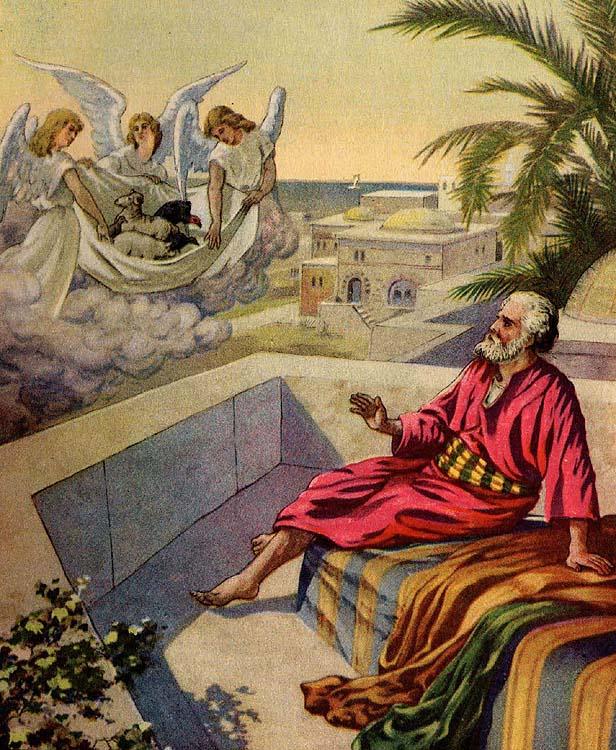
Have you ever wanted God to speak loudly and clearly to you, to let you know without a doubt His desires?
God does speak to us, but usually in very subtle ways.
Have you ever had an experience that you thought was just a coincidence but later realized that through that experience you became closer to God or gained a better understanding of some part of the Gospel?
This is one of the methods that the Holy Spirit uses on all people. We call this Prevenient Grace. Prevenient literally means "coming before". This is any experience of grace that comes before a profession of faith or before any conscious growth in faith. Any time we are awakened to sin in our lives or awakened to new challenges and opportunities we have experienced Prevenient Grace.
When we get into the scripture for this week, we will see several instances of the Holy Spirit working in peoples lives prior to a change in belief or attitude. The Holy Spirit’s presence in this story of Peter and the Cornelius is obvious. This presence is not always so obvious in events in our lives, but many times looking back we can see that obviously the Spirit was at work on us or in us.
This lesson is in a way a coincidence of the Holy Spirit teaching some of us in this church, especially me. As we will see the main point of this passage is of Peter overcoming a personal and cultural prejudice and opening the Gospel to everyone. This is not the first lesson I have had this week on this very topic.
Our Wednesday night book study group has been reading What’s So Amazing About Grace by Philip Yancey. Yancey is a journalist who writes a column for Christianity Today magazine and has also written about a dozen books. This week we read chapter ten, "The Arsenal of Grace". This chapter tells of several instances of grace overcoming prejudice, some as dramatic as Peter in today’s lesson.
From page 123 of What’s So Amazing About Grace:
Walter Wink tells of two peacemakers who visited a group of Polish Christians ten years after the end of World War II. "Would you be willing to meet with other Christians from West Germany?" The peacemakers asked. "They want to ask forgiveness for what Germany did to Poland during the was and to begin to build a new relationship."
At first their was silence. Then one Pole stood up. "What you are asking is impossible. Each stone of Warsaw is soaked in Polish blood! We cannot forgive!"
Before the group parted, however, they said the Lord’s Prayer together. When they reached the words, "forgive us our sins as we forgive...." everyone stopped praying. Tension swelled in the room. The Pole who had spoken so vehemently said, "I must say yes to you. I could no more pray the Our Father, I could no more call myself a Christian, if I refuse to forgive. Humanly speaking I cannot do it, but God will give us His strength!"
Eighteen months later the Polish and West German Christians met together in Vienna, establishing friendships that continue to this day.
Can you see in that instance how the Holy Spirit spoke to these people through the words of a prayer taken directly from scripture?
That is an instance of grace preceding a reconciliation. Prior to reconciliation some bitter prejudices had to be eliminated.
How do cultural and religious barriers hinder growth in our faith?
Who are we most likely to witness our faith to, or invite to share our faith, or invite to church?
Those who are most like us and have the most in common with us.
Let’s get into this weeks scripture:
At Caesarea there was a man named Cornelius, a centurion of what was known as the Italian Cohort, a devout man who feared God with all his household, gave alms generously to the people, and prayed continually to God. About the ninth hour of the day he saw clearly in a vision an angel of God come in and say to him, "Cornelius." And he stared at him in terror and said, "What is it, Lord?" And he said to him, "Your prayers and your alms have ascended as a memorial before God. And now send men to Joppa and bring one Simon who is called Peter. He is lodging with one Simon, a tanner, whose house is by the seaside." When the angel who spoke to him had departed, he called two of his servants and a devout soldier from among those who attended him, and having related everything to them, he sent them to Joppa.
(Act 10:1-8 ESV)
What can we know about Cornelius from this passage?
- He lived in Caesarea, the Roman capital of Judea.
- He was a centurion, the commander of a century, a group of one hundred Roman soldiers.
- His century was part of the "Italian Cohort". A cohort was six hundred soldiers, one tenth of a legion.
- He "feared God with all his household, gave alms generously...., and prayed continually."
With just these few facts, what do you think the average Jew in Palestine would have thought of Cornelius?
- They probably would not have had very much respect for him. They may have shown respect out of fear of Cornelius’ position, but probably would have inwardly despised him.
- As an officer in the Roman army, Cornelius represented those who forcefully occupied the Jewish homeland.
- As a gentile, Cornelius was considered impure and any type of relationship between Jew and Gentile was off-limits according to Jewish interpretation of the Law.
What does it mean to say that Cornelius "feared God"?
- He believed the Jewish tradition of "One God". He probably accepted the Mosaic law and participated as much as was allowed in Jewish worship.
- Cornelius "feared God, ..gave alms, ..and prayed", obviously very devout and religious.
But what did his religion lack?
His religion did not offer salvation. Many people, even today, are confident that their character and religion are the way of salvation. While everyone who truly seeks out the Lord will not receive a visit from an angel, if they truly seek they will find. Grace is at work in all people, but sometimes is applied more readily on those who place themselves in it’s path.
Cornelius was not at this point a Christian, as he had not yet even heard the gospel.
How do you know when God is speaking to you?
- Cornelius was visited by the angel.
- The Polish man in the other story knew that God was speaking through a prayer from scripture.
- I am pretty certain that God has spoken to me by giving me two lessons in one week on the same subject.
When you know that God is speaking to you, when should you act?
Without hesitation. This angel did not give Cornelius any explanation as to who Peter was or the purpose for summoning him. He was spoken to and responded immediately.
The next day, as they were on their journey and approaching the city, Peter went up on the housetop about the sixth hour to pray. And he became hungry and wanted something to eat, but while they were preparing it, he fell into a trance and saw the heavens opened and something like a great sheet descending, being let down by its four corners upon the earth. In it were all kinds of animals and reptiles and birds of the air. And there came a voice to him: "Rise, Peter; kill and eat." But Peter said, "By no means, Lord; for I have never eaten anything that is common or unclean." And the voice came to him again a second time, "What God has made clean, do not call common." This happened three times, and the thing was taken up at once to heaven.
(Act 10:9-16 ESV)
"By no means, Lord...."
How often do you think the Spirit is answered with something similar?
Should we wait for understanding before obeying?
Even when what we are asked to do is totally confusing and contrary to popular beliefs?
On first observation what seems to be the message in Peter’s dream?
It could be understood as God repealing the dietary laws of the old covenant, but in actuality this message goes far beyond the diet. God has made clean all that was considered unclean under the old laws. Those laws were not intended to literally declare lists of clean and unclean. Those laws were intended to establish an identity for God’s chosen people. God’s people could be recognized as different from all others because of their ritual practices. God now declares that all who are saved by grace through faith are His chosen people.
How easy is it in today’s world to recognize God’s chosen people?
Now while Peter was inwardly perplexed as to what the vision that he had seen might mean, behold, the men who were sent by Cornelius, having made inquiry for Simon's house, stood at the gate and called out to ask whether Simon who was called Peter was lodging there. And while Peter was pondering the vision, the Spirit said to him, "Behold, three men are looking for you. Rise and go down and accompany them without hesitation, for I have sent them."
(Act 10:17-20 ESV)
Did Peter immediately recognize the significance of his vision?
Here is one of those Holy coincidences that sometimes help one to understand that grace is working in one’s life. Peter was shown in a vision, now he will be shown in reality.
How do you think Peter felt when told to kill and eat unclean food?
How do you think Peter felt when asked to accompany "unclean" Gentiles to the home of another Gentile who also happened to be a Roman Centurion?
What are some reasons that we avoid or reject some people?
So Peter accompanies them back to Caesarea:
And he said to them, "You yourselves know how unlawful it is for a Jew to associate with or to visit anyone of another nation, but God has shown me that I should not call any person common or unclean. So when I was sent for, I came without objection. I ask then why you sent for me."
(Act 10:28-29 ESV)
And Cornelius said, "Four days ago, about this hour, I was praying in my house at the ninth hour, and behold, a man stood before me in bright clothing and said, 'Cornelius, your prayer has been heard and your alms have been remembered before God. Send therefore to Joppa and ask for Simon who is called Peter. He is lodging in the house of Simon, a tanner, by the sea.' So I sent for you at once, and you have been kind enough to come. Now therefore we are all here in the presence of God to hear all that you have been commanded by the Lord." So Peter opened his mouth and said: "Truly I understand that God shows no partiality, but in every nation anyone who fears him and does what is right is acceptable to him. As for the word that he sent to Israel, preaching good news of peace through Jesus Christ (he is Lord of all),
(Act 10:30-36 ESV)
While Peter was still saying these things, the Holy Spirit fell on all who heard the word. And the believers from among the circumcised who had come with Peter were amazed, because the gift of the Holy Spirit was poured out even on the Gentiles. For they were hearing them speaking in tongues and extolling God. Then Peter declared, "Can anyone withhold water for baptizing these people, who have received the Holy Spirit just as we have?" And he commanded them to be baptized in the name of Jesus Christ.
(Act 10:44-48 ESV)
The Body of Christ was changed by these two men who responded to their respective visions. Cornelius, a God-fearing man, learned of Jesus, received the Holy Spirit, confessed faith and was baptized into the Body. Peter, who prior to this event despised the Gentiles, rejected the Jewish purity laws and opened the Gospel to the Gentiles. This story tells the beginning of the Body of Christ as we know it today.
How should the church treat visitors or seekers who are different from the rest of the congregation?
How can we show or prove our acceptance of those who are different?
Another excerpt from What’s So Amazing About Grace:
I grew up a racist. (Yancey is speaking of his own experience.) Although not yet fifty years old, I remember well when the South practiced a perfectly legal form of apartheid. Stores in downtown Atlanta had three rest room: White Men, White Women, and Colored. Gas stations had two drinking fountains, one for Whites and one for Colored...
(In speaking of his childhood church)....it was there I learned a twisted theological basis for my racism.
In the 1960's the church deacon board mobilized lookout squads, and on Sundays these took turns patrolling the entrances lest any black "troublemakers" try to integrate us. I still have on of the cards the deacons printed up to give to any civil rights demonstrators who might appear:
"Believing the motives of your group to be ulterior and foreign to the teaching of God’s word, we cannot extend a welcome to you and respectfully request you to leave the premises quietly. Scripture does NOT teach "the brotherhood of man and the fatherhood of God." He is the Creator of all, but only the Father of those who have been regenerated....."
(Yancey goes on to tell how the South and the Nation changed. There are many African-Americans involved in all levels of business, culture, and politics. Even folks like George Wallace asked forgiveness for former acts and attitudes....)
Even my childhood church learned to repent......The church seemed cursed, blighted. It had tried new pastors and new programs, but nothing worked. Though the leaders sought African-American participation, few in the neighborhood responded.
Finally the pastor, a classmate of mine from childhood, took the unusual step of scheduling a service of repentance.......publicly, painfully, with African-American leaders present, he recounted the sin of racism as it had been practiced by the church in the past. He confessed- and received their forgiveness.
Although a burden seemed to lift from the congregation after that service, it was not sufficient to save the church. A few years later the white congregation moved out to the suburbs, and today a rousing African-American congregation....fills the building and rattles its windows once more.
All people, regardless of race, ethnicity, language, culture, age, socio-economic class, gender, or other man-made divisions must be told the truth of the Gospel. The truth that God loves them. Peter had a vision sent by the Holy Spirit to help him overcome his cultural prejudice. How can we overcome whatever prejudices that may be holding us back from sharing the Good News with people who are different from us?
Subscribe to:
Posts (Atom)